
CHAPTER II
Were his nurses comely or harsh-looking? Fionn would not know. This was the one who picked him up when he fell, and that was the one who patted the bruise. This one said: “Mind you do not tumble in the well!”
And that one: “Mind the little knees among the nettles.”
But he did tumble and record that the only notable thing about a well is that it is wet. And as for nettles, if they hit him he hit back. He slashed into them with a stick and brought them low. There was nothing in wells or nettles, only women dreaded them. One patronised women and instructed them and comforted them, for they were afraid about one.
They thought that one should not climb a tree!
“Next week,” they said at last, “you may climb this one,” and “next week” lived at the end of the world!
But the tree that was climbed was not worth while when it had been climbed twice. There was a bigger one near by. There were trees that no one could climb, with vast shadow on one side and vaster sunshine on the other. It took a long time to walk round them, and you could not see their tops.
It was pleasant to stand on a branch that swayed and sprung, and it was good to stare at an impenetrable roof of leaves and then climb into it. How wonderful the loneliness was up there! When he looked down there was an undulating floor of leaves, green and green and greener to a very blackness of greeniness; and when he looked up there were leaves again, green and less green and not green at all, up to a very snow and blindness of greeniness; and above and below and around there was sway and motion, the whisper of leaf on leaf, and the eternal silence to which one listened and at which one tried to look.
When he was six years of age his mother, beautiful, long-haired Muirne, came to see him. She came secretly, for she feared the sons of Morna, and she had paced through lonely places in many counties before she reached the hut in the wood, and the cot where he lay with his fists shut and sleep gripped in them.
He awakened to be sure. He would have one ear that would catch an unusual voice, one eye that would open, however sleepy the other one was. She took him in her arms and kissed him, and she sang a sleepy song until the small boy slept again.
We may be sure that the eye that could stay open stayed open that night as long as it could, and that the one ear listened to the sleepy song until the song got too low to be heard, until it was too tender to be felt vibrating along those soft arms, until Fionn was asleep again, with a new picture in his little head and a new notion to ponder on.
The mother of himself! His own mother!
But when he awakened she was gone.
She was going back secretly, in dread of the sons of Morna, slipping through gloomy woods, keeping away from habitations, getting by desolate and lonely ways to her lord in Kerry.
Perhaps it was he that was afraid of the sons of Morna, and perhaps she loved him.
CHAPTER III
THE women Druids, his guardians, belonged to his father’s people. Bovmall was Uail’s sister, and, consequently, Fionn’s aunt. Only such a blood-tie could have bound them to the clann-Baiscne, for it is not easy, having moved in the world of court and camp, to go hide with a baby in a wood; and to live, as they must have lived, in terror.
What stories they would have told the child of the sons of Morna. Of Morna himself, the huge-shouldered, stern-eyed, violent Connachtman; and of his sons—young Goll Mor mac Morna in particular, as huge-shouldered as his father, as fierce in the onset, but merry-eyed when the other was grim, and bubbling with a laughter that made men forgive even his butcheries. Of Cona’n Mael mac Morna his brother, gruff as a badger, bearded like a boar, bald as a crow, and with a tongue that could manage an insult where another man would not find even a stammer. His boast was that when he saw an open door he went into it, and when he saw a closed door he went into it. When he saw a peaceful man he insulted him, and when he met a man who was not peaceful he insulted him. There was Garra Duv mac Morna, and savage Art Og, who cared as little for their own skins as they did for the next man’s, and Garra must have been rough indeed to have earned in that clan the name of the Rough mac Morna. There were others: wild Connachtmen all, as untameable, as unaccountable as their own wonderful countryside.
Fionn would have heard much of them, and it is likely that he practised on a nettle at taking the head off Goll, and that he hunted a sheep from cover in the implacable manner he intended later on for Cona’n the Swearer.
But it is of Uail mac Baiscne he would have heard most. With what a dilation of spirit the ladies would have told tales of him, Fionn’s father. How their voices would have become a chant as feat was added to feat, glory piled on glory. The most famous of men and the most beautiful; the hardest fighter; the easiest giver; the kingly champion; the chief of the Fianna na h-Eirinn. Tales of how he had been way-laid and got free; of how he had been generous and got free; of how he had been angry and went marching with the speed of an eagle and the direct onfall of a storm; while in front and at the sides, angled from the prow of his terrific advance, were fleeing multitudes who did not dare to wait and scarce had time to run. And of how at last, when the time came to quell him, nothing less than the whole might of Ireland was sufficient for that great downfall.
We may be sure that on these adventures Fionn was with his father, going step for step with the long-striding hero, and heartening him mightily.
CHAPTER IV
He was given good training by the women in running and leaping and swimming.
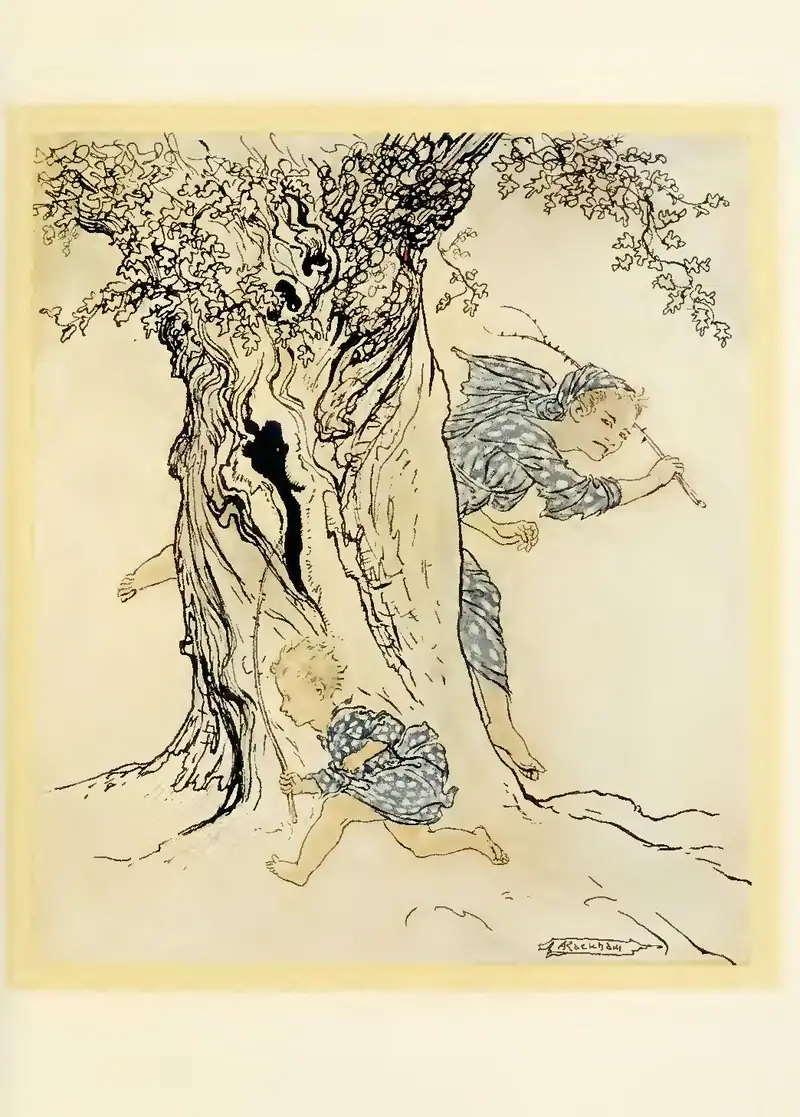
One of them would take a thorn switch in her hand, and Fionn would take a thorn switch in his hand, and each would try to strike the other running round a tree.
You had to go fast to keep away from the switch behind, and a small boy feels a switch. Fionn would run his best to get away from that prickly stinger, but how he would run when it was his turn to deal the strokes!
With reason too, for his nurses had suddenly grown implacable. They pursued him with a savagery which he could not distinguish from hatred, and they swished him well whenever they got the chance.
Fionn learned to run. After a while he could buzz around a tree like a maddened fly, and oh, the joy, when he felt himself drawing from the switch and gaining from behind on its bearer! How he strained and panted to catch on that pursuing person and pursue her and get his own switch into action.
Original Size
He learned to jump by chasing hares in a bumpy field. Up went the hare and up went Fionn, and away with the two of them, hopping and popping across the field. If the hare turned while Fionn was after her it was switch for Fionn; so that in a while it did not matter to Fionn which way the hare jumped for he could jump that way too. Long-ways, sideways or baw-ways, Fionn hopped where the hare hopped, and at last he was the owner of a hop that any hare would give an ear for.
He was taught to swim, and it may be that his heart sank when he fronted the lesson. The water was cold. It was deep. One could see the bottom, leagues below, millions of miles below. A small boy might shiver as he stared into that wink and blink and twink of brown pebbles and murder. And these implacable women threw him in!
Perhaps he would not go in at first. He may have smiled at them, and coaxed, and hung back. It was a leg and an arm gripped then; a swing for Fionn, and out and away with him; plop and flop for him; down into chill deep death for him, and up with a splutter; with a sob; with a grasp at everything that caught nothing; with a wild flurry; with a raging despair; with a bubble and snort as he was hauled again down, and down, and down, and found as suddenly that he had been hauled out.
Fionn learned to swim until he could pop into the water like an otter and slide through it like an eel.
He used to try to chase a fish the way he chased hares in the bumpy field—but there are terrible spurts in a fish. It may be that a fish cannot hop, but he gets there in a flash, and he isn’t there in another. Up or down, sideways or endways, it is all one to a fish. He goes and is gone. He twists this way and disappears the other way. He is over you when he ought to be under you, and he is biting your toe when you thought you were biting his tail.
You cannot catch a fish by swimming, but you can try, and Fionn tried. He got a grudging commendation from the terrible women when he was able to slip noiselessly in the tide, swim under water to where a wild duck was floating and grip it by the leg.
“Qu—,” said the duck, and he disappeared before he had time to get the “-ack” out of him.
So the time went, and Fionn grew long and straight and tough like a sapling; limber as a willow, and with the flirt and spring of a young bird. One of the ladies may have said, “He is shaping very well, my dear,” and the other replied, as is the morose privilege of an aunt, “He will never be as good as his father,” but their hearts must have overflowed in the night, in the silence, in the darkness, when they thought of the living swiftness they had fashioned, and that dear fair head.