
OISIN’S MOTHER
Original Size
CHAPTER I
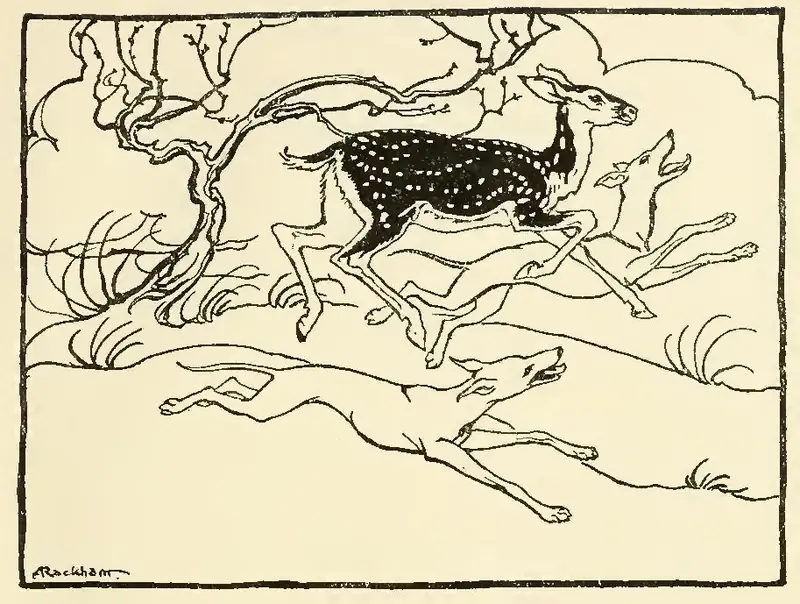
EVENING was drawing nigh, and the Fianna-Finn had decided to hunt no more that day. The hounds were whistled to heel, and a sober, homeward march began. For men will walk soberly in the evening, however they go in the day, and dogs will take the mood from their masters. They were pacing so, through the golden-shafted, tender-coloured eve, when a fawn leaped suddenly from covert, and, with that leap, all quietness vanished: the men shouted, the dogs gave tongue, and a furious chase commenced.
Fionn loved a chase at any hour, and, with Bran and Sceo’lan, he outstripped the men and dogs of his troop, until nothing remained in the limpid world but Fionn, the two hounds, and the nimble, beautiful fawn. These, and the occasional boulders, round which they raced, or over which they scrambled; the solitary tree which dozed aloof and beautiful in the path, the occasional clump of trees that hived sweet shadow as a hive hoards honey, and the rustling grass that stretched to infinity, and that moved and crept and swung under the breeze in endless, rhythmic billowings.
In his wildest moment Fionn was thoughtful, and now, although running hard, he was thoughtful. There was no movement of his beloved hounds that he did not know; not a twitch or fling of the head, not a cock of the ears or tail that was not significant to him. But on this chase whatever signs the dogs gave were not understood by their master.
He had never seen them in such eager flight. They were almost utterly absorbed in it, but they did not whine with eagerness, nor did they cast any glance towards him for the encouraging word which he never failed to give when they sought it.
They did look at him, but it was a look which he could not comprehend. There was a question and a statement in those deep eyes, and he could not understand what that question might be, nor what it was they sought to convey. Now and again one of the dogs turned a head in full flight, and stared, not at Fionn, but distantly backwards, over the spreading and swelling plain where their companions of the hunt had disappeared. “They are looking for the other hounds,” said Fionn.
“And yet they do not give tongue! Tongue it, a Vran!” he shouted, “Bell it out, a Heo’lan!”
It was then they looked at him, the look which he could not understand and had never seen on a chase. They did not tongue it, nor bell it, but they added silence to silence and speed to speed, until the lean grey bodies were one pucker and lashing of movement.
Fionn marvelled. “They do not want the other dogs to hear or to come on this chase,” he murmured, and he wondered what might be passing within those slender heads.
“The fawn runs well,” his thought continued. “What is it, a Vran, my heart? After her, a Heo’lan! Hist and away, my loves!”
“There is going and to spare in that beast yet,” his mind went on. “She is not stretched to the full, nor half stretched. She may outrun even Bran,” he thought ragingly.
They were racing through a smooth valley in a steady, beautiful, speedy flight when, suddenly, the fawn stopped and lay on the grass, and it lay with the calm of an animal that has no fear, and the leisure of one that is not pressed.
“Here is a change,” said Fionn, staring in astonishment.
“She is not winded,” he said. “What is she lying down for?” But Bran and Sceo’lan did not stop; they added another inch to their long-stretched easy bodies, and came up on the fawn.
“It is an easy kill,” said Fionn regretfully. “They have her,” he cried.
But he was again astonished, for the dogs did not kill. They leaped and played about the fawn, licking its face, and rubbing delighted noses against its neck.
Fionn came up then. His long spear was lowered in his fist at the thrust, and his sharp knife was in its sheath, but he did not use them, for the fawn and the two hounds began to play round him, and the fawn was as affectionate towards him as the hounds were; so that when a velvet nose was thrust in his palm, it was as often a fawn’s muzzle as a hound’s.
In that joyous company he came to wide Allen of Leinster, where the people were surprised to see the hounds and the fawn and the Chief and none other of the hunters that had set out with them.
When the others reached home, the Chief told of his chase, and it was agreed that such a fawn must not be killed, but that it should be kept and well treated, and that it should be the pet fawn of the Fianna. But some of those who remembered Brah’s parentage thought that as Bran herself had come from the Shi so this fawn might have come out of the Shi also.
CHAPTER II
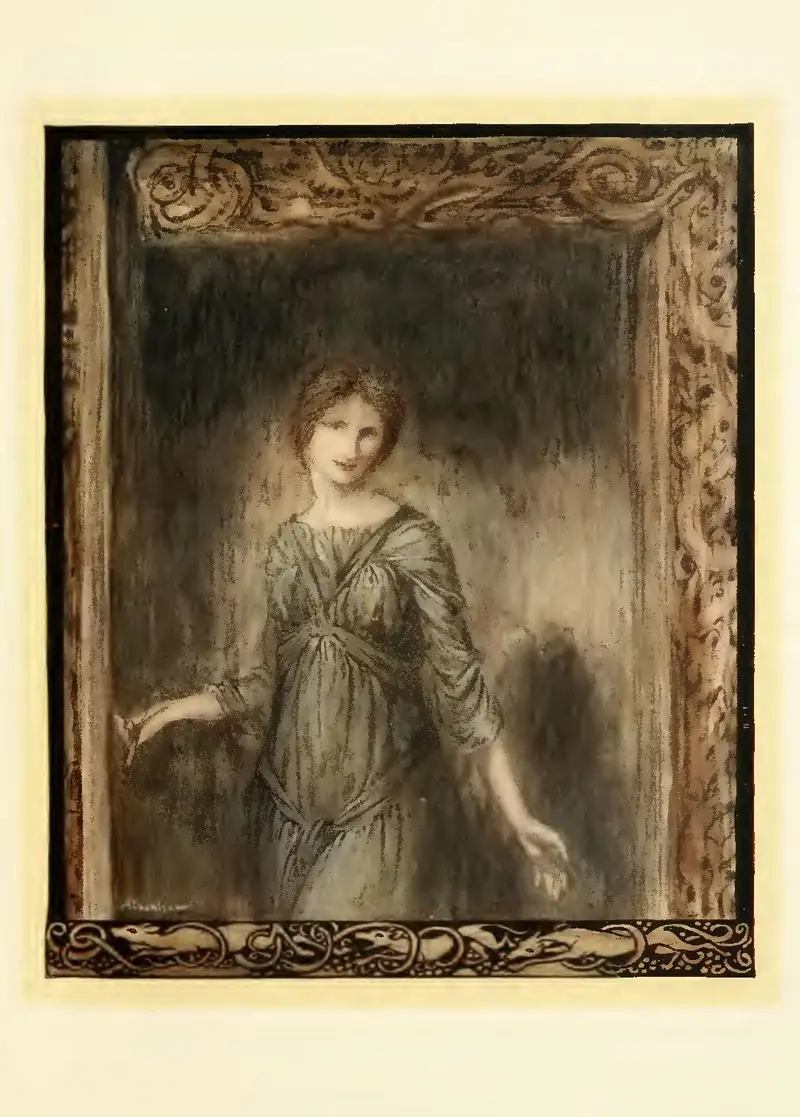
Late that night, when he was preparing for rest, the door of Fionn’s chamber opened gently and a young woman came into the room. The captain stared at her, as he well might, for he had never seen or imagined to see a woman so beautiful as this was. Indeed, she was not a woman, but a young girl, and her bearing was so gently noble, her look so modestly high, that the champion dared scarcely look at her, although he could not by any means have looked away.
As she stood within the doorway, smiling, and shy as a flower, beautifully timid as a fawn, the Chief communed with his heart.
“She is the Sky-woman of the Dawn,” he said. “She is the light on the foam. She is white and odorous as an apple-blossom. She smells of spice and honey. She is my beloved beyond the women of the world. She shall never be taken from me.”
And that thought was delight and anguish to him: delight because of such sweet prospect, anguish because it was not yet realised, and might not be.
As the dogs had looked at him on the chase with a look that he did not understand, so she looked at him, and in her regard there was a question that baffled him and a statement which he could not follow.
He spoke to her then, mastering his heart to do it.
“I do not seem to know you,” he said.
“You do not know me indeed,” she replied.
“It is the more wonderful,” he continued gently, “for I should know every person that is here. What do you require from me?”
“I beg your protection, royal captain.”
“I give that to all,” he answered. “Against whom do you desire protection?”
“I am in terror of the Fear Doirche.”
“The Dark Man of the Shi?”
“He is my enemy,” she said.
“He is mine now,” said Fionn. “Tell me your story.”
“My name is Saeve, and I am a woman of Faery,” she commenced. “In the Shi’ many men gave me their love, but I gave my love to no man of my country.”
“That was not reasonable,” the other chided with a blithe heart.
“I was contented,” she replied, “and what we do not want we do not lack. But if my love went anywhere it went to a mortal, a man of the men of Ireland.”
“By my hand,” said Fionn in mortal distress, “I marvel who that man can be!”
“He is known to you,” she murmured. “I lived thus in the peace of Faery, hearing often of my mortal champion, for the rumour of his great deeds had gone through the Shi’, until a day came when the Black Magician of the Men of God put his eye on me, and, after that day, in whatever direction I looked I saw his eye.”
Original Size
She stopped at that, and the terror that was in her heart was on her face. “He is everywhere,” she whispered. “He is in the bushes, and on the hill. He looked up at me from the water, and he stared down on me from the sky. His voice commands out of the spaces, and it demands secretly in the heart. He is not here or there, he is in all places at all times. I cannot escape from him,” she said, “and I am afraid,” and at that she wept noiselessly and stared on Fionn.
“He is my enemy,” Fionn growled. “I name him as my enemy.”
“You will protect me,” she implored.
“Where I am let him not come,” said Fionn. “I also have knowledge. I am Fionn, the son of Uail, the son of Baiscne, a man among men and a god where the gods are.”
“He asked me in marriage,” she continued, “but my mind was full of my own dear hero, and I refused the Dark Man.”
“That was your right, and I swear by my hand that if the man you desire is alive and unmarried he shall marry you or he will answer to me for the refusal.”
“He is not married,” said Saeve, “and you have small control over him.” The Chief frowned thoughtfully. “Except the High King and the kings I have authority in this land.”
“What man has authority over himself?” said Saeve.
“Do you mean that I am the man you seek?” said Fionn.
“It is to yourself I gave my love,” she replied. “This is good news,” Fionn cried joyfully, “for the moment you came through the door I loved and desired you, and the thought that you wished for another man went into my heart like a sword.” Indeed, Fionn loved Saeve as he had not loved a woman before and would never love one again. He loved her as he had never loved anything before. He could not bear to be away from her. When he saw her he did not see the world, and when he saw the world without her it was as though he saw nothing, or as if he looked on a prospect that was bleak and depressing. The belling of a stag had been music to Fionn, but when Saeve spoke that was sound enough for him. He had loved to hear the cuckoo calling in the spring from the tree that is highest in the hedge, or the blackbird’s jolly whistle in an autumn bush, or the thin, sweet enchantment that comes to the mind when a lark thrills out of sight in the air and the hushed fields listen to the song. But his wife’s voice was sweeter to Fionn than the singing of a lark. She filled him with wonder and surmise. There was magic in the tips of her fingers. Her thin palm ravished him. Her slender foot set his heart beating; and whatever way her head moved there came a new shape of beauty to her face.
“She is always new,” said Fionn. “She is always better than any other woman; she is always better than herself.”
He attended no more to the Fianna. He ceased to hunt. He did not listen to the songs of poets or the curious sayings of magicians, for all of these were in his wife, and something that was beyond these was in her also.
“She is this world and the next one; she is completion,” said Fionn.