
CHAPTER II
He had not gone a great distance from Ben Edair when he came to an intricate, gloomy wood, where the trees grew so thickly and the undergrowth was such a sprout and tangle that one could scarcely pass through it. He remembered that a path had once been hacked through the wood, and he sought for this. It was a deeply scooped, hollow way, and it ran or wriggled through the entire length of the wood.
Into this gloomy drain Fionn descended and made progress, but when he had penetrated deeply in the dank forest he heard a sound of thumping and squelching footsteps, and he saw coming towards him a horrible, evil-visaged being; a wild, monstrous, yellow-skinned, big-boned giant, dressed in nothing but an ill-made, mud-plastered, drab-coloured coat, which swaggled and clapped against the calves of his big bare legs. On his stamping feet there were great brogues of boots that were shaped like, but were bigger than, a boat, and each time he put a foot down it squashed and squirted a barrelful of mud from the sunk road.
Fionn had never seen the like of this vast person, and he stood gazing on him, lost in a stare of astonishment.
The great man saluted him.
“All alone, Fionn?” he cried. “How does it happen that not one Fenian of the Fianna is at the side of his captain?” At this inquiry Fionn got back his wits.
“That is too long a story and it is too intricate and pressing to be told, also I have no time to spare now.”
“Yet tell it now,” the monstrous man insisted.
Fionn, thus pressed, told of the coming of Cael of the Iron, of the challenge the latter had issued, and that he, Fionn, was off to Tara of the Kings to find Caelte mac Rona’n.
“I know that foreigner well,” the big man commented.
“Is he the champion he makes himself out to be?” Fionn inquired.
“He can do twice as much as he said he would do,” the monster replied.
“He won’t outrun Caelte mac Rona’n,” Fionn asserted. The big man jeered.
“Say that he won’t outrun a hedgehog, dear heart. This Cael will end the course by the time your Caelte begins to think of starting.”
“Then,” said Fionn, “I no longer know where to turn, or how to protect the honour of Ireland.”
“I know how to do these things,” the other man commented with a slow nod of the head.
“If you do,” Fionn pleaded, “tell it to me upon your honour.”
“I will do that,” the man replied.
“Do not look any further for the rusty-kneed, slow-trotting son of Rona’n,” he continued, “but ask me to run your race, and, by this hand, I will be first at the post.”
At this the Chief began to laugh.
“My good friend, you have work enough to carry the two tons of mud that are plastered on each of your coat-tails, to say nothing of your weighty boots.”
“By my hand,” the man cried, “there is no person in Ireland but myself can win that race. I claim a chance.”
Fionn agreed then. “Be it so,” said he. “And now, tell me your name?”
“I am known as the Carl of the Drab Coat.”
“All names are names,” Fionn responded, “and that also is a name.”
They returned then to Ben Edair.
CHAPTER III
When they came among the host the men of Ireland gathered about the vast stranger; and there were some who hid their faces in their mantles so that they should not be seen to laugh, and there were some who rolled along the ground in merriment, and there were others who could only hold their mouths open and crook their knees and hang their arms and stare dumbfoundedly upon the stranger, as though they were utterly dazed.
Cael of the Iron came also on the scene, and he examined the stranger with close and particular attention.
“What in the name of the devil is this thing?” he asked of Fionn.
“Dear heart,” said Fionn, “this is the champion I am putting against you in the race.”
Cael of the Iron grew purple in the face, and he almost swallowed his tongue through wrath.
“Until the end of eternity,” he roared, “and until the very last moment of doom I will not move one foot in a race with this greasy, big-hoofed, ill-assembled resemblance of a beggarman.”
But at this the Carl burst into a roar of laughter, so that the eardrums of the warriors present almost burst inside of their heads.
“Be reassured, my darling, I am no beggarman, and my quality is not more gross than is the blood of the most delicate prince in this assembly. You will not evade your challenge in that way, my love, and you shall run with me or you shall run to your ship with me behind you. What length of course do you propose, dear heart?”
“I never run less than sixty miles,” Cael replied sullenly.
“It is a small run,” said the Carl, “but it will do. From this place to the Hill of the Rushes, Slieve Luachra of Munster, is exactly sixty miles. Will that suit you?”
“I don’t care how it is done,” Cael answered.
“Then,” said the Carl, “we may go off to Slieve Luachra now, and in the morning we can start our race there to here.”
“Let it be done that way,” said Cael.
These two set out then for Munster, and as the sun was setting they reached Slieve Luachra and prepared to spend the night there.
Original Size
CHAPTER IV
“Cael, my pulse,” said the Carl, “we had better build a house or a hut to pass the night in.”
“I’Il build nothing,” Cael replied, looking on the Carl with great disfavour.
“No!”
“I won’t build house or hut for the sake of passing one night here, for I hope never to see this place again.”
“I’Il build a house myself,” said the Carl, “and the man who does not help in the building can stay outside of the house.”
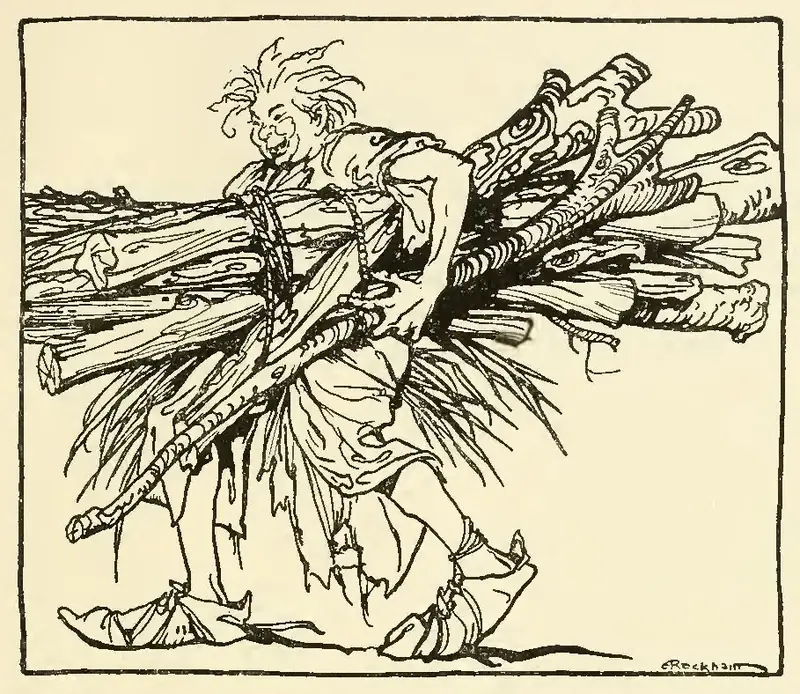
The Carl stumped to a near-by wood, and he never rested until he had felled and tied together twenty-four couples of big timber. He thrust these under one arm and under the other he tucked a bundle of rushes for his bed, and with that one load he rushed up a house, well thatched and snug, and with the timber that remained over he made a bonfire on the floor of the house.
His companion sat at a distance regarding the work with rage and aversion.
“Now Cael, my darling,” said the Carl, “if you are a man help me to look for something to eat, for there is game here.”
“Help yourself,” roared Cael, “for all that I want is not to be near you.”
“The tooth that does not help gets no helping,” the other replied.
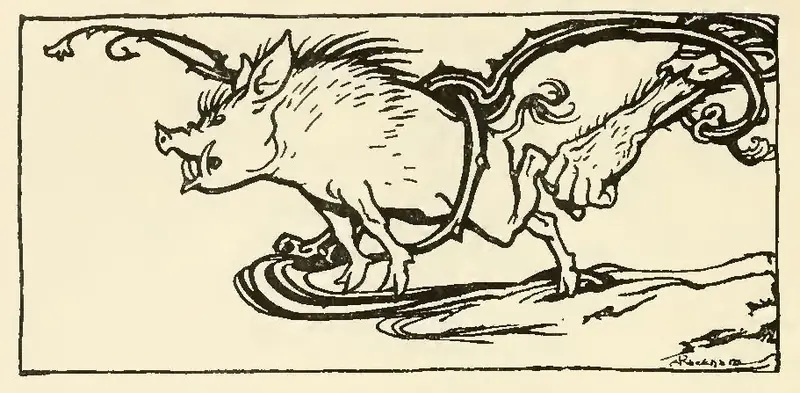
In a short time the Carl returned with a wild boar which he had run down. He cooked the beast over his bonfire and ate one half of it, leaving the other half for his breakfast. Then he lay down on the rushes, and in two turns he fell asleep.
But Cael lay out on the side of the hill, and if he went to sleep that night he slept fasting. It was he, however, who awakened the Carl in the morning.
“Get up, beggarman, if you are going to run against me.”
The Carl rubbed his eyes.
“I never get up until I have had my fill of sleep, and there is another hour of it due to me. But if you are in a hurry, my delight, you can start running now with a blessing. I will trot on your track when I waken up.”
Cael began to race then, and he was glad of the start, for his antagonist made so little account of him that he did not know what to expect when the Carl would begin to run.
“Yet,” said Cael to himself, “with an hour’s start the beggarman will have to move his bones if he wants to catch on me,” and he settled down to a good, pelting race.
Original Size