
CHAPTER XI
THE fisherman of Cairill, the King of Ulster, took me in his net. Ah, that was a happy man when he saw me! He shouted for joy when he saw the great salmon in his net.
“I was still in the water as he hauled delicately. I was still in the water as he pulled me to the bank. My nose touched air and spun from it as from fire, and I dived with all my might against the bottom of the net, holding yet to the water, loving it, mad with terror that I must quit that loveliness. But the net held and I came up.
“‘Be quiet, King of the River,’ said the fisherman, ‘give in to Doom,’ said he.
“I was in air, and it was as though I were in fire. The air pressed on me like a fiery mountain. It beat on my scales and scorched them. It rushed down my throat and scalded me. It weighed on me and squeezed me, so that my eyes felt as though they must burst from my head, my head as though it would leap from my body, and my body as though it would swell and expand and fly in a thousand pieces.
“The light blinded me, the heat tormented me, the dry air made me shrivel and gasp; and, as he lay on the grass, the great salmon whirled his desperate nose once more to the river, and leaped, leaped, leaped, even under the mountain of air. He could leap upwards, but not forwards, and yet he leaped, for in each rise he could see the twinkling waves, the rippling and curling waters.
“‘Be at ease, O King,’ said the fisherman. ‘Be at rest, my beloved. Let go the stream. Let the oozy marge be forgotten, and the sandy bed where the shades dance all in green and gloom, and the brown flood sings along.’
“And as he carried me to the palace he sang a song of the river, and a song of Doom, and a song in praise of the King of the Waters.
“When the king’s wife saw me she desired me. I was put over a fire and roasted, and she ate me. And when time passed she gave birth to me, and I was her son and the son of Cairill the king. I remember warmth and darkness and movement and unseen sounds. All that happened I remember, from the time I was on the gridiron until the time I was born. I forget nothing of these things.”
“And now,” said Finnian, “you will be born again, for I shall baptize you into the family of the Living God.” —— So far the story of Tuan, the son of Cairill.
No man knows if he died in those distant ages when Finnian was Abbot of Moville, or if he still keeps his fort in Ulster, watching all things, and remembering them for the glory of God and the honour of Ireland.
THE BOYHOOD OF FIONN
He was a king, a seer and a poet. He was a lord with a manifold and great train. He was our magician, our knowledgable one, our soothsayer. All that he did was sweet with him. And, however ye deem my testimony of Fionn excessive, and, although ye hold my praising overstrained, nevertheless, and by the King that is above me, he was three times better than all I say.—Saint PATRICK.
Original Size
CHAPTER I
Fionn [pronounce Fewn to rhyme with “tune”] got his first training among women. There is no wonder in that, for it is the pup’s mother teaches it to fight, and women know that fighting is a necessary art although men pretend there are others that are better. These were the women druids, Bovmall and Lia Luachra. It will be wondered why his own mother did not train him in the first natural savageries of existence, but she could not do it. She could not keep him with her for dread of the clann-Morna. The sons of Morna had been fighting and intriguing for a long time to oust her husband, Uail, from the captaincy of the Fianna of Ireland, and they had ousted him at last by killing him. It was the only way they could get rid of such a man; but it was not an easy way, for what Fionn’s father did not know in arms could not be taught to him even by Morna. Still, the hound that can wait will catch a hare at last, and even Manana’nn sleeps. Fionn’s mother was beautiful, long-haired Muirne: so she is always referred to. She was the daughter of Teigue, the son of Nuada from Faery, and her mother was Ethlinn. That is, her brother was Lugh of the Long Hand himself, and with a god, and such a god, for brother we may marvel that she could have been in dread of Morna or his sons, or of any one. But women have strange loves, strange fears, and these are so bound up with one another that the thing which is presented to us is not often the thing that is to be seen.
However it may be, when Uall died Muirne got married again to the King of Kerry. She gave the child to Bovmall and Lia Luachra to rear, and we may be sure that she gave injunctions with him, and many of them. The youngster was brought to the woods of Slieve Bloom and was nursed there in secret.
It is likely the women were fond of him, for other than Fionn there was no life about them. He would be their life; and their eyes may have seemed as twin benedictions resting on the small fair head. He was fair-haired, and it was for his fairness that he was afterwards called Fionn; but at this period he was known as Deimne. They saw the food they put into his little frame reproduce itself length-ways and sideways in tough inches, and in springs and energies that crawled at first, and then toddled, and then ran. He had birds for playmates, but all the creatures that live in a wood must have been his comrades. There would have been for little Fionn long hours of lonely sunshine, when the world seemed just sunshine and a sky. There would have been hours as long, when existence passed like a shade among shadows, in the multitudinous tappings of rain that dripped from leaf to leaf in the wood, and slipped so to the ground. He would have known little snaky paths, narrow enough to be filled by his own small feet, or a goat’s; and he would have wondered where they went, and have marvelled again to find that, wherever they went, they came at last, through loops and twists of the branchy wood, to his own door. He may have thought of his own door as the beginning and end of the world, whence all things went, and whither all things came.
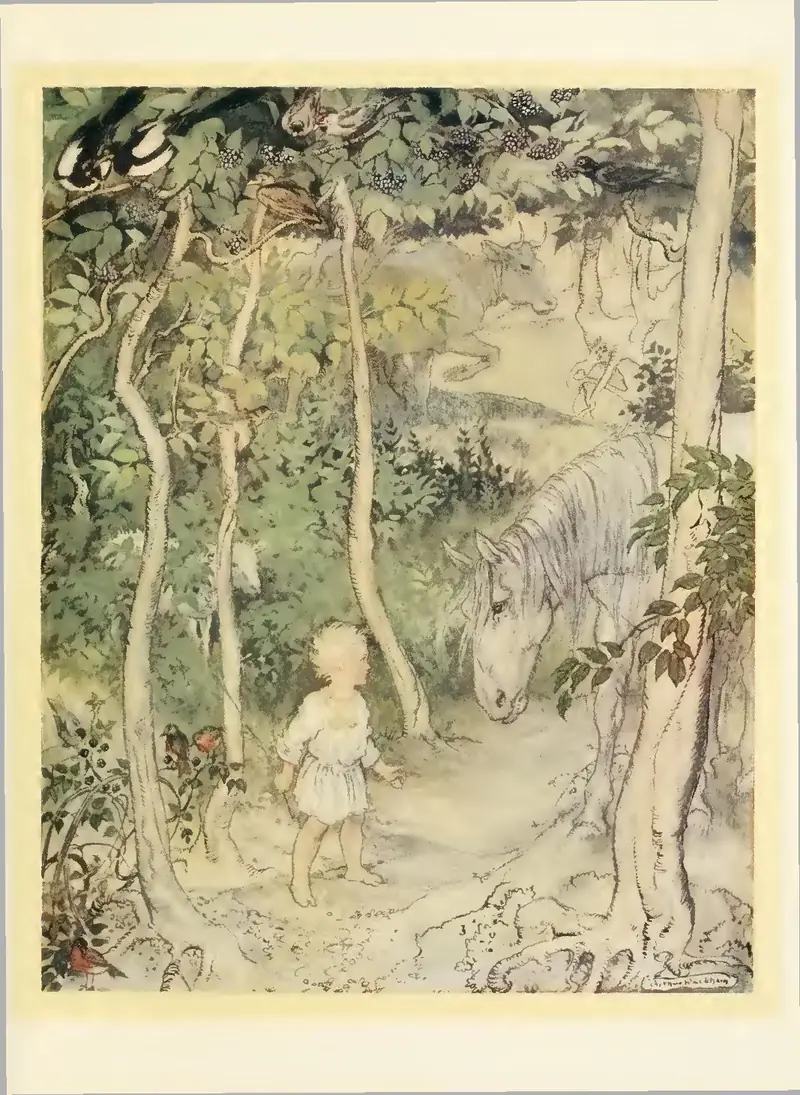
Perhaps he did not see the lark for a long time, but he would have heard him, far out of sight in the endless sky, thrilling and thrilling until the world seemed to have no other sound but that clear sweetness; and what a world it was to make that sound! Whistles and chirps, coos and caws and croaks, would have grown familiar to him. And he could at last have told which brother of the great brotherhood was making the noise he heard at any moment. The wind too: he would have listened to its thousand voices as it moved in all seasons and in all moods. Perhaps a horse would stray into the thick screen about his home, and would look as solemnly on Fionn as Fionn did on it. Or, coming suddenly on him, the horse might stare, all a-cock with eyes and ears and nose, one long-drawn facial extension, ere he turned and bounded away with manes all over him and hoofs all under him and tails all round him. A solemn-nosed, stern-eyed cow would amble and stamp in his wood to find a flyless shadow; or a strayed sheep would poke its gentle muzzle through leaves.
“A boy,” he might think, as he stared on a staring horse, “a boy cannot wag his tail to keep the flies off,” and that lack may have saddened him. He may have thought that a cow can snort and be dignified at the one moment, and that timidity is comely in a sheep. He would have scolded the jackdaw, and tried to out-whistle the throstle, and wondered why his pipe got tired when the blackbird’s didn’t. There would be flies to be watched, slender atoms in yellow gauze that flew, and filmy specks that flittered, and sturdy, thick-ribbed brutes that pounced like cats and bit like dogs and flew like lightning. He may have mourned for the spider in bad luck who caught that fly. There would be much to see and remember and compare, and there would be, always, his two guardians. The flies change from second to second; one cannot tell if this bird is a visitor or an inhabitant, and a sheep is just sister to a sheep; but the women were as rooted as the house itself.
Original Size