
CHAPTER IV
There is a difference between this world and the world of Faery, but it is not immediately perceptible. Everything that is here is there, but the things that are there are better than those that are here. All things that are bright are there brighter. There is more gold in the sun and more silver in the moon of that land. There is more scent in the flowers, more savour in the fruit. There is more comeliness in the men and more tenderness in the women. Everything in Faery is better by this one wonderful degree, and it is by this betterness you will know that you are there if you should ever happen to get there.
Mongan and his companions stepped from the world of storm into sunshine and a scented world. The instant they stepped they stood, bewildered, looking at each other silently, questioningly, and then with one accord they turned to look back whence they had come.
There was no storm behind them. The sunlight drowsed there as it did in front, a peaceful flooding of living gold. They saw the shapes of the country to which their eyes were accustomed, and recognised the well-known landmarks, but it seemed that the distant hills were a trifle higher, and the grass which clothed them and stretched between was greener, was more velvety: that the trees were better clothed and had more of peace as they hung over the quiet ground.
But Mongan knew what had happened, and he smiled with glee as he watched his astonished companions, and he sniffed that balmy air as one whose nostrils remembered it.
“You had better come with me,” he said.
“Where are we?” his wife asked. “Why, we are here,” cried Mongan; “where else should we be?”
He set off then, and the others followed, staring about them cautiously, and each man keeping a hand on the hilt of his sword.
“Are we in Faery?” the Flame Lady asked.
“We are,” said Mongan.
When they had gone a little distance they came to a grove of ancient trees. Mightily tail and well grown these trees were, and the trunk of each could not have been spanned by ten broad men. As they went among these quiet giants into the dappled obscurity and silence, their thoughts became grave, and all the motions of their minds elevated as though they must equal in greatness and dignity those ancient and glorious trees. When they passed through the grove they saw a lovely house before them, built of mellow wood and with a roof of bronze—it was like the dwelling of a king, and over the windows of the Sunny Room there was a balcony. There were ladies on this balcony, and when they saw the travellers approaching they sent messengers to welcome them.
Mongan and his companions were then brought into the house, and all was done for them that could be done for honoured guests. Everything within the house was as excellent as all without, and it was inhabited by seven men and seven women, and it was evident that Mongan and these people were well acquainted.
In the evening a feast was prepared, and when they had eaten well there was a banquet. There were seven vats of wine, and as Mongan loved wine he was very happy, and he drank more on that occasion than any one had ever noticed him to drink before.
It was while he was in this condition of glee and expansion that the Flame Lady put her arms about his neck and begged he would tell her the story of Duv Laca, and, being boisterous then and full of good spirits, he agreed to her request, and he prepared to tell the tale.
The seven men and seven women of the Fairy Palace then took their places about him in a half-circle; his own seven guards sat behind them; his wife, the Flame Lady, sat by his side; and at the back of all Cairid, his story-teller sat, listening with all his ears, and remembering every word that was uttered.
CHAPTER V
Said Mongan:
In the days of long ago and the times that have disappeared for ever, there was one Fiachna Finn the son of Baltan, the son of Murchertach, the son of Muredach, the son of Eogan, the son of Neill. He went from his own country when he was young, for he wished to see the land of Lochlann, and he knew that he would be welcomed by the king of that country, for Fiachna’s father and Eolgarg’s father had done deeds in common and were obliged to each other.
He was welcomed, and he stayed at the Court of Lochlann in great ease and in the midst of pleasures.
It then happened that Eolgarg Mor fell sick and the doctors could not cure him. They sent for other doctors, but they could not cure him, nor could any one say what he was suffering from, beyond that he was wasting visibly before their eyes, and would certainly become a shadow and disappear in air unless he was healed and fattened and made visible.
They sent for more distant doctors, and then for others more distant still, and at last they found a man who claimed that he could make a cure if the king were supplied with the medicine which he would order.
“What medicine is that?” said they all.
“This is the medicine,” said the doctor. “Find a perfectly white cow with red ears, and boil it down in the lump, and if the king drinks that rendering he will recover.”
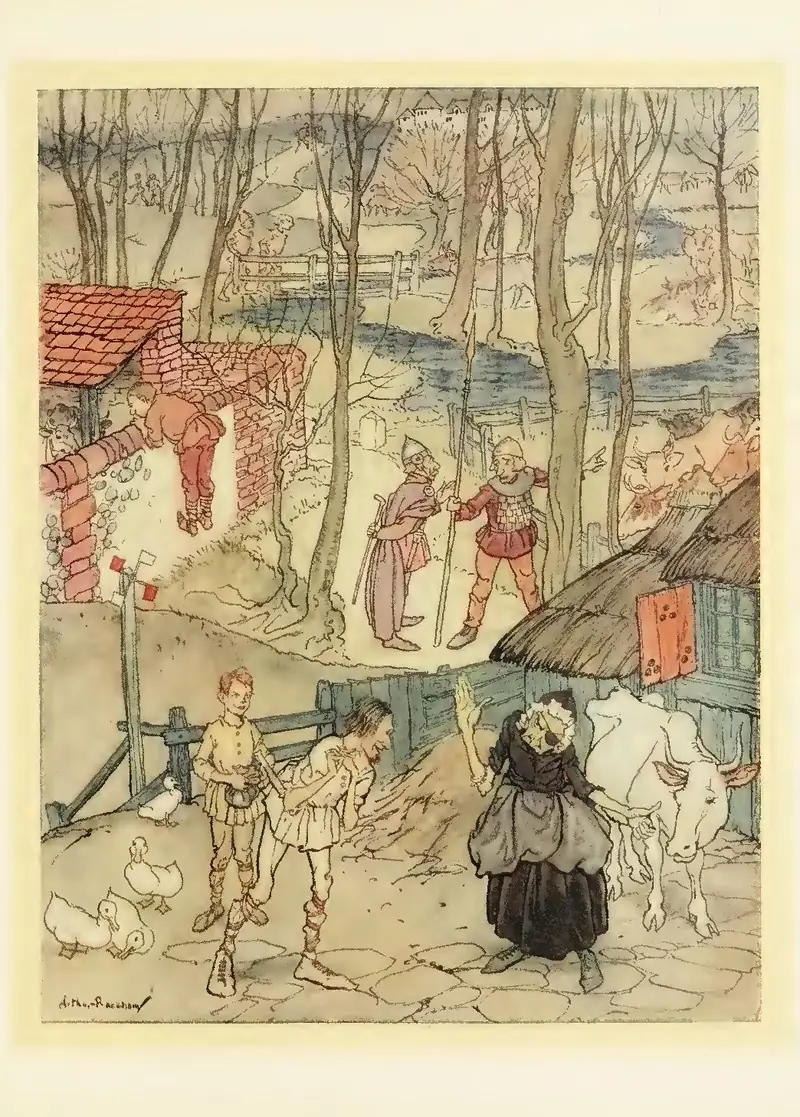
Before he had well said it messengers were going from the palace in all directions looking for such a cow. They found lots of cows which were nearly like what they wanted, but it was only by chance they came on the cow which would do the work, and that beast belonged to the most notorious and malicious and cantankerous female in Lochlann, the Black Hag. Now the Black Hag was not only those things that have been said; she was also whiskered and warty and one-eyed and obstreperous, and she was notorious and ill-favoured in many other ways also.
They offered her a cow in the place of her own cow, but she refused to give it. Then they offered a cow for each leg of her cow, but she would not accept that offer unless Fiachna went bail for the payment. He agreed to do so, and they drove the beast away.
On the return journey he was met by messengers who brought news from Ireland. They said that the King of Ulster was dead, and that he, Fiachna Finn, had been elected king in the dead king’s place. He at once took ship for Ireland, and found that all he had been told was true, and he took up the government of Ulster.
Original Size