
CHAPTER IV
It is part of the education of a prince to be a good chess player, and to continually exercise his mind in view of the judgements that he will be called upon to give and the knotty, tortuous, and perplexing matters which will obscure the issues which he must judge. Art, the son of Conn, was sitting at chess with Cromdes, his father’s magician.
“Be very careful about the move you are going to make,” said Cromdes.
“CAN I be careful?” Art inquired. “Is the move that you are thinking of in my power?”
“It is not,” the other admitted.
“Then I need not be more careful than usual,” Art replied, and he made his move.
“It is a move of banishment,” said Cromdes.
“As I will not banish myself, I suppose my father will do it, but I do not know why he should.”
“Your father will not banish you.”
“Who then?” “Your mother.”
“My mother is dead.”
“You have a new one,” said the magician.
“Here is news,” said Art. “I think I shall not love my new mother.”
“You will yet love her better than she loves you,” said Cromdes, meaning thereby that they would hate each other.
While they spoke the king and Becuma entered the palace.
“I had better go to greet my father,” said the young man.
“You had better wait until he sends for you,” his companion advised, and they returned to their game.
In due time a messenger came from the king directing Art to leave Tara instantly, and to leave Ireland for one full year.
He left Tara that night, and for the space of a year he was not seen again in Ireland. But during that period things did not go well with the king nor with Ireland. Every year before that time three crops of corn used to be lifted off the land, but during Art’s absence there was no corn in Ireland and there was no milk. The whole land went hungry.
Lean people were in every house, lean cattle in every field; the bushes did not swing out their timely berries or seasonable nuts; the bees went abroad as busily as ever, but each night they returned languidly, with empty pouches, and there was no honey in their hives when the honey season came. People began to look at each other questioningly, meaningly, and dark remarks passed between them, for they knew that a bad harvest means, somehow, a bad king, and, although this belief can be combated, it is too firmly rooted in wisdom to be dismissed.
The poets and magicians met to consider why this disaster should have befallen the country and by their arts they discovered the truth about the king’s wife, and that she was Becuma of the White Skin, and they discovered also the cause of her banishment from the Many-Coloured Land that is beyond the sea, which is beyond even the grave.
They told the truth to the king, but he could not bear to be parted from that slender-handed, gold-haired, thin-lipped, blithe enchantress, and he required them to discover some means whereby he might retain his wife and his crown. There was a way and the magicians told him of it.
“If the son of a sinless couple can be found and if his blood be mixed with the soll of Tara the blight and ruin will depart from Ireland,” said the magicians.
“If there is such a boy I will find him,” cried the Hundred Fighter.
At the end of a year Art returned to Tara. His father delivered to him the sceptre of Ireland, and he set out on a journey to find the son of a sinless couple such as he had been told of.
Original Size
CHAPTER V
The High King did not know where exactly he should look for such a saviour, but he was well educated and knew how to look for whatever was lacking. This knowledge will be useful to those upon whom a similar duty should ever devolve.
He went to Ben Edair. He stepped into a coracle and pushed out to the deep, and he permitted the coracle to go as the winds and the waves directed it.
In such a way he voyaged among the small islands of the sea until he lost all knowledge of his course and was adrift far out in ocean. He was under the guidance of the stars and the great luminaries.
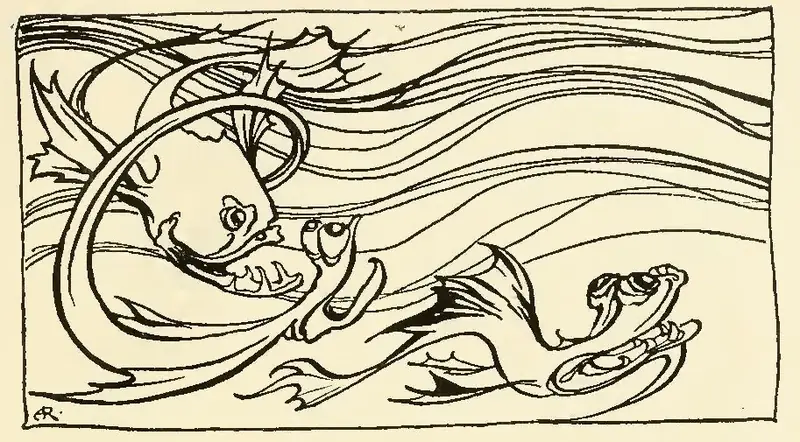
He saw black seals that stared and barked and dived dancingly, with the round turn of a bow and the forward onset of an arrow. Great whales came heaving from the green-hued void, blowing a wave of the sea high into the air from their noses and smacking their wide flat tails thunder-ously on the water. Porpoises went snorting past in bands and clans. Small fish came sliding and flickering, and all the outlandish creatures of the deep rose by his bobbing craft and swirled and sped away.
Wild storms howled by him so that the boat climbed painfully to the sky on a mile-high wave, balanced for a tense moment on its level top, and sped down the glassy side as a stone goes furiously from a sling.
Or, again, caught in the chop of a broken sea, it stayed shuddering and backing, while above his head there was only a low sad sky, and around him the lap and wash of grey waves that were never the same and were never different.
After long staring on the hungry nothingness of air and water he would stare on the skin-stretched fabric of his boat as on a strangeness, or he would examine his hands and the texture of his skin and the stiff black hairs that grew behind his knuckles and sprouted around his ring, and he found in these things newness and wonder.
Then, when days of storm had passed, the low grey clouds shivered and cracked in a thousand places, each grim islet went scudding to the horizon as though terrified by some great breadth, and when they had passed he stared into vast after vast of blue infinity, in the depths of which his eyes stayed and could not pierce, and wherefrom they could scarcely be withdrawn. A sun beamed thence that filled the air with sparkle and the sea with a thousand lights, and looking on these he was reminded of his home at Tara: of the columns of white and yellow bronze that blazed out sunnily on the sun, and the red and white and yellow painted roofs that beamed at and astonished the eye.
Sailing thus, lost in a succession of days and nights, of winds and calms, he came at last to an island.
His back was turned to it, and long before he saw it he smelled it and wondered; for he had been sitting as in a daze, musing on a change that had seemed to come in his changeless world; and for a long time he could not tell what that was which made a difference on the salt-whipped wind or why he should be excited. For suddenly he had become excited and his heart leaped in violent expectation.
“It is an October smell,” he said.
“It is apples that I smell.”
He turned then and saw the island, fragrant with apple trees, sweet with wells of wine; and, hearkening towards the shore, his ears, dulled yet with the unending rhythms of the sea, distinguished and were filled with song; for the isle was, as it were, a nest of birds, and they sang joyously, sweetly, triumphantly.
He landed on that lovely island, and went forward under the darting birds, under the apple boughs, skirting fragrant lakes about which were woods of the sacred hazel and into which the nuts of knowledge fell and swam; and he blessed the gods of his people because of the ground that did not shiver and because of the deeply rooted trees that could not gad or budge.