
CHAPTER II
Conn the Hundred Fighter, Ard-Ri’ of Ireland, was in the lowest spirits that can be imagined, for his wife was dead. He had been Ard-Ri for nine years, and during his term the corn used to be reaped three times in each year, and there was full and plenty of everything. There are few kings who can boast of more kingly results than he can, but there was sore trouble in store for him.
He had been married to Eithne, the daughter of Brisland Binn, King of Norway, and, next to his subjects, he loved his wife more than all that was lovable in the world. But the term of man and woman, of king or queen, is set in the stars, and there is no escaping Doom for any one; so, when her time came, Eithne died.
Now there were three great burying-places in Ireland—the Brugh of the Boyne in Ulster, over which Angus Og is chief and god; the Shi’ mound of Cruachan Ahi, where Ethal Anbual presides over the underworld of Connacht, and Tailltin, in Royal Meath. It was in this last, the sacred place of his own lordship, that Conn laid his wife to rest.
Her funeral games were played during nine days. Her keen was sung by poets and harpers, and a cairn ten acres wide was heaved over her clay. Then the keening ceased and the games drew to an end; the princes of the Five Prov-inces returned by horse or by chariot to their own places; the concourse of mourners melted away, and there was nothing left by the great cairn but the sun that dozed upon it in the daytime, the heavy clouds that brooded on it in the night, and the desolate, memoried king.
For the dead queen had been so lovely that Conn could not forget her; she had been so kind at every moment that he could not but miss her at every moment; but it was in the Council Chamber and the Judgement Hall that he most pondered her memory. For she had also been wise, and lack-ing her guidance, all grave affairs seemed graver, shadowing each day and going with him to the pillow at night.
The trouble of the king becomes the trouble of the subject, for how shall we live if judgement is withheld, or if faulty decisions are promulgated? Therefore, with the sorrow of the king, all Ireland was in grief, and it was the wish of every person that he should marry again.
Such an idea, however, did not occur to him, for he could not conceive how any woman should fill the place his queen had vacated. He grew more and more despondent, and less and less fitted to cope with affairs of state, and one day he instructed his son Art to take the rule during his absence, and he set out for Ben Edair.
For a great wish had come upon him to walk beside the sea; to listen to the roll and boom of long, grey breakers; to gaze on an unfruitful, desolate wilderness of waters; and to forget in those sights all that he could forget, and if he could not forget then to remember all that he should remember.
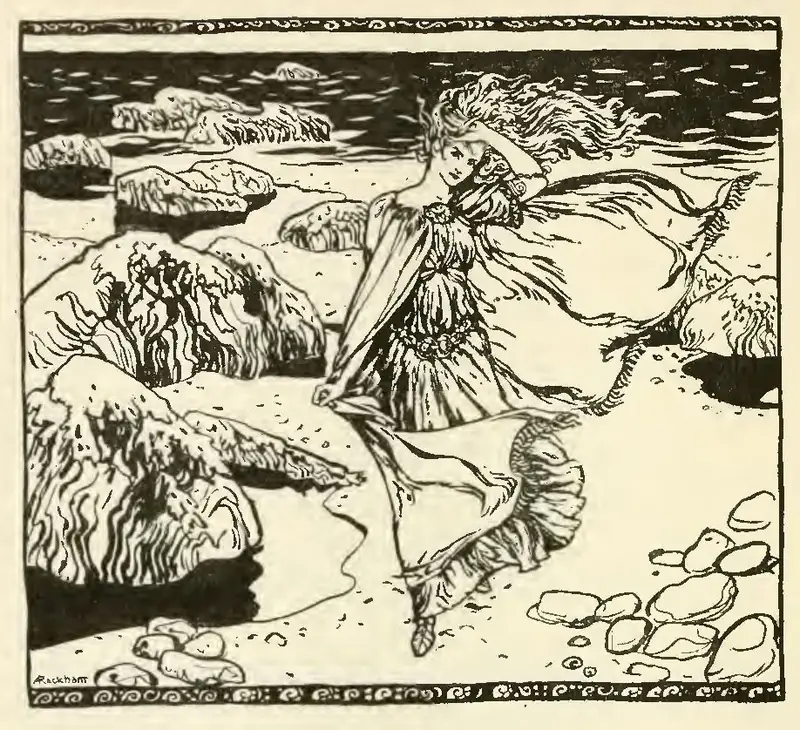
He was thus gazing and brooding when one day he observed a coracle drawing to the shore. A young girl stepped from it and walked to him among black boulders and patches of yellow sand.
Original Size
CHAPTER III
Being a king he had authority to ask questions. Conn asked her, therefore, all the questions that he could think of, for it is not every day that a lady drives from the sea, and she wearing a golden-fringed cloak of green silk through which a red satin smock peeped at the openings. She replied to his questions, but she did not tell him all the truth; for, indeed, she could not afford to.
She knew who he was, for she retained some of the powers proper to the worlds she had left, and as he looked on her soft yellow hair and on her thin red lips, Conn recognised, as all men do, that one who is lovely must also be good, and so he did not frame any inquiry on that count; for everything is forgotten in the presence of a pretty woman, and a magician can be bewitched also.
She told Conn that the fame of his son Art had reached even the Many-Coloured Land, and that she had fallen in love with the boy. This did not seem unreasonable to one who had himself ventured much in Faery, and who had known so many of the people of that world leave their own land for the love of a mortal.
“What is your name, my sweet lady?” said the king.
“I am called Delvcaem (Fair Shape) and I am the daughter of Morgan,” she replied.
“I have heard much of Morgan,” said the king. “He is a very great magician.”
During this conversation Conn had been regarding her with the minute freedom which is right only in a king. At what precise instant he forgot his dead consort we do not know, but it is certain that at this moment his mind was no longer burdened with that dear and lovely memory. His voice was melancholy when he spoke again.
“You love my son!”
“Who could avoid loving him?” she murmured.
“When a woman speaks to a man about the love she feels for another man she is not liked. And,” he continued, “when she speaks to a man who has no wife of his own about her love for another man then she is disliked.”
“I would not be disliked by you,” Becuma murmured.
“Nevertheless,” said he regally, “I will not come between a woman and her choice.”
“I did not know you lacked a wife,” said Becuma, but indeed she did.
“You know it now,” the king replied sternly.
“What shall I do?” she inquired, “am I to wed you or your son?”
“You must choose,” Conn answered.
“If you allow me to choose it means that you do not want me very badly,” said she with a smile.
“Then I will not allow you to choose,” cried the king, “and it is with myself you shall marry.”
He took her hand in his and kissed it.
“Lovely is this pale thin hand. Lovely is the slender foot that I see in a small bronze shoe,” said the king.
After a suitable time she continued:
“I should not like your son to be at Tara when I am there, or for a year afterwards, for I do not wish to meet him until I have forgotten him and have come to know you well.”
“I do not wish to banish my son,” the king protested.
“It would not really be a banishment,” she said. “A prince’s duty could be set him, and in such an absence he would improve his knowledge both of Ireland and of men. Further,” she continued with downcast eyes, “when you remember the reason that brought me here you will see that his presence would be an embarrassment to us both, and my presence would be unpleasant to him if he remembers his mother.”
“Nevertheless,” said Conn stubbornly, “I do not wish to banish my son; it is awkward and unnecessary.”
“For a year only,” she pleaded.
“It is yet,” he continued thoughtfully, “a reasonable reason that you give and I will do what you ask, but by my hand and word I don’t like doing it.”
They set out then briskly and joyfully on the homeward journey, and in due time they reached Tara of the Kings.