
CHAPTER VII
“I used to live,” he said, “in a wide, beautiful place. There were hills and valleys there, and woods and streams, but in whatever direction I went I came always to a cliff, so tall it seemed to lean against the sky, and so straight that even a goat would not have imagined to climb it.”
“I do not know of any such place,” Fionn mused.
“There is no such place in Ireland,” said Caelte, “but in the Shi’ there is such a place.”
“There is in truth,” said Fionn.
“I used to eat fruits and roots in the summer,” the boy continued, “but in the winter food was left for me in a cave.”
“Was there no one with you?” Fionn asked.
“No one but a deer that loved me, and that I loved.”
“Ah me!” cried Fionn in anguish, “tell me your tale, my son.”
“A dark stern man came often after us, and he used to speak with the deer. Sometimes he talked gently and softly and coaxingly, but at times again he would shout loudly and in a harsh, angry voice. But whatever way he talked the deer would draw away from him in dread, and he always left her at last furiously.”
“It is the Dark Magician of the Men of God,” cried Fionn despairingly.
“It is indeed, my soul,” said Caelte.
“The last time I saw the deer,” the child continued, “the dark man was speaking to her. He spoke for a long time. He spoke gently and angrily, and gently and angrily, so that I thought he would never stop talking, but in the end he struck her with a hazel rod, so that she was forced to follow him when he went away. She was looking back at me all the time and she was crying so bitterly that any one would pity her. I tried to follow her also, but I could not move, and I cried after her too, with rage and grief, until I could see her no more and hear her no more. Then I fell on the grass, my senses went away from me, and when I awoke I was on the hill in the middle of the hounds where you found me.”
That was the boy whom the Fianna called Oisi’n, or the Little Fawn. He grew to be a great fighter afterwards, and he was the chief maker of poems in the world. But he was not yet finished with the Shi. He was to go back into Faery when the time came, and to come thence again to tell these tales, for it was by him these tales were told.
THE WOOING OF BECFOLA
Original Size
CHAPTER I
We do not know where Becfola came from. Nor do we know for certain where she went to. We do not even know her real name, for the name Becfola, “Dowerless” or “Small-dowered,” was given to her as a nickname. This only is certain, that she disappeared from the world we know of, and that she went to a realm where even conjecture may not follow her.
It happened in the days when Dermod, son of the famous Ae of Slane, was monarch of all Ireland. He was unmarried, but he had many foster-sons, princes from the Four Provinces, who were sent by their fathers as tokens of loyalty and affection to the Ard-Ri, and his duties as a foster-father were righteously acquitted. Among the young princes of his household there was one, Crimthann, son of Ae, King of Leinster, whom the High King preferred to the others over whom he held fatherly sway. Nor was this wonderful, for the lad loved him also, and was as eager and intelligent and modest as becomes a prince.
The High King and Crimthann would often set out from Tara to hunt and hawk, sometimes unaccompanied even by a servant; and on these excursions the king imparted to his foster-son his own wide knowledge of forest craft, and advised him generally as to the bearing and duties of a prince, the conduct of a court, and the care of a people.
Dermod mac Ae delighted in these solitary adventures, and when he could steal a day from policy and affairs he would send word privily to Crimthann. The boy, having donned his hunting gear, would join the king at a place arranged between them, and then they ranged abroad as chance might direct.
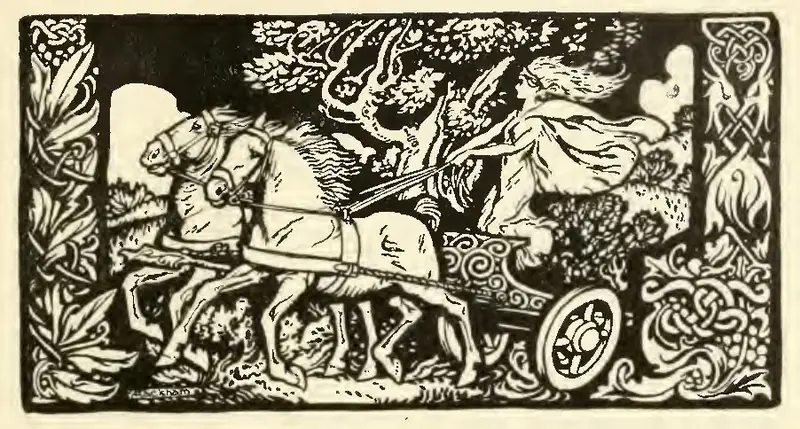
On one of these adventures, as they searched a flooded river to find the ford, they saw a solitary woman in a chariot driving from the west.
“I wonder what that means?” the king exclaimed thoughtfully.
“Why should you wonder at a woman in a chariot?” his companion inquired, for Crimthann loved and would have knowledge.
“Good, my Treasure,” Dermod answered, “our minds are astonished when we see a woman able to drive a cow to pasture, for it has always seemed to us that they do not drive well.”
Crimthann absorbed instruction like a sponge and digested it as rapidly.
“I think that is justly said,” he agreed.
“But,” Dermod continued, “when we see a woman driving a chariot of two horses, then we are amazed indeed.”
When the machinery of anything is explained to us we grow interested, and Crimthann became, by instruction, as astonished as the king was.
“In good truth,” said he, “the woman is driving two horses.”
“Had you not observed it before?” his master asked with kindly malice.
“I had observed but not noticed,” the young man admitted.
“Further,” said the king, “surmise is aroused in us when we discover a woman far from a house; for you will have both observed and noticed that women are home-dwellers, and that a house without a woman or a woman without a house are imperfect objects, and although they be but half observed, they are noticed on the double.”
“There is no doubting it,” the prince answered from a knitted and thought-tormented brow.
“We shall ask this woman for information about herself,” said the king decidedly.
“Let us do so,” his ward agreed
“The king’s majesty uses the words ‘we’ and ‘us’ when referring to the king’s majesty,” said Dermod, “but princes who do not yet rule territories must use another form of speech when referring to themselves.”
“I am very thoughtless,” said Crimthann humbly.
The king kissed him on both cheeks.
“Indeed, my dear heart and my son, we are not scolding you, but you must try not to look so terribly thoughtful when you think. It is part of the art of a ruler.”
“I shall never master that hard art,” lamented his fosterling.
“We must all master it,” Dermod replied. “We may think with our minds and with our tongues, but we should never think with our noses and with our eyebrows.”
The woman in the chariot had drawn nigh to the ford by which they were standing, and, without pause, she swung her steeds into the shallows and came across the river in a tumult of foam and spray.
“Does she not drive well?” cried Crimthann admiringly.
“When you are older,” the king counselled him, “you will admire that which is truly admirable, for although the driving is good the lady is better.”
He continued with enthusiasm.
“She is in truth a wonder of the world and an endless delight to the eye.”
She was all that and more, and, as she took the horses through the river and lifted them up the bank, her flying hair and parted lips and all the young strength and grace of her body went into the king’s eye and could not easily come out again.
Nevertheless, it was upon his ward that the lady’s gaze rested, and if the king could scarcely look away from her, she could, but only with an equal effort, look away from Crimthann.
“Halt there!” cried the king.
“Who should I halt for?” the lady demanded, halting all the same, as is the manner of women, who rebel against command and yet receive it.
“Halt for Dermod!”
“There are Dermods and Dermods in this world,” she quoted.
“There is yet but one Ard-Ri’,” the monarch answered.
She then descended from the chariot and made her reverence.
“I wish to know your name?” said he.
But at this demand the lady frowned and answered decidedly:
“I do not wish to tell it.”
“I wish to know also where you come from and to what place you are going?”
“I do not wish to tell any of these things.”
“Not to the king!”
“I do not wish to tell them to any one.”
Crimthann was scandalised.
“Lady,” he pleaded, “you will surely not withhold information from the Ard-Ri’?”
But the lady stared as royally on the High King as the High King did on her, and, whatever it was he saw in those lovely eyes, the king did not insist.
He drew Crimthann apart, for he withheld no instruction from that lad.
“My heart,” he said, “we must always try to act wisely, and we should only insist on receiving answers to questions in which we are personally concerned.”
Crimthann imbibed all the justice of that remark.
“Thus I do not really require to know this lady’s name, nor do I care from what direction she comes.”
“You do not?” Crimthann asked.
“No, but what I do wish to know is, Will she marry me?”
“By my hand that is a notable question,” his companion stammered.
“It is a question that must be answered,” the king cried triumphantly. “But,” he continued, “to learn what woman she is, or where she comes from, might bring us torment as well as information. Who knows in what adventures the past has engaged her!”
And he stared for a profound moment on disturbing, sinister horizons, and Crimthann meditated there with him.
“The past is hers,” he concluded, “but the future is ours, and we shall only demand that which is pertinent to the future.”
He returned to the lady.
“We wish you to be our wife,” he said. And he gazed on her benevolently and firmly and carefully when he said that, so that her regard could not stray otherwhere. Yet, even as he looked, a tear did well into those lovely eyes, and behind her brow a thought moved of the beautiful boy who was looking at her from the king’s side.
But when the High King of Ireland asks us to marry him we do not refuse, for it is not a thing that we shall be asked to do every day in the week, and there is no woman in the world but would love to rule it in Tara.
No second tear crept on the lady’s lashes, and, with her hand in the king’s hand, they paced together towards the palace, while behind them, in melancholy mood, Crimthann mac Ae led the horses and the chariot.
Original Size