
CHAPTER XIV
He listened to the retreating footsteps until they could be heard no more, and the one sound that came to his tense ears was the beating of his own heart.
Even the wind had ceased, and there seemed to be nothing in the world but the darkness and himself. In that gigantic blackness, in that unseen quietude and vacancy, the mind could cease to be personal to itself. It could be overwhelmed and merged in space, so that consciousness would be transferred or dissipated, and one might sleep standing; for the mind fears loneliness more than all else, and will escape to the moon rather than be driven inwards on its own being.
But Fionn was not lonely, and he was not afraid when the son of Midna came.
A long stretch of the silent night had gone by, minute following minute in a slow sequence, wherein as there was no change there was no time; wherein there was no past and no future, but a stupefying, endless present which is almost the annihilation of consciousness. A change came then, for the clouds had also been moving and the moon at last was sensed behind them—not as a radiance, but as a percolation of light, a gleam that was strained through matter after matter and was less than the very wraith or remembrance of itself; a thing seen so narrowly, so sparsely, that the eye could doubt if it was or was not seeing, and might conceive that its own memory was re-creating that which was still absent.
But Fionn’s eye was the eye of a wild creature that spies on darkness and moves there wittingly. He saw, then, not a thing but a movement; something that was darker than the darkness it loomed on; not a being but a presence, and, as it were, impending pressure. And in a little he heard the deliberate pace of that great being.
Fionn bent to his spear and unloosed its coverings.
Then from the darkness there came another sound; a low, sweet sound; thrillingly joyous, thrillingly low; so low the ear could scarcely note it, so sweet the ear wished to catch nothing else and would strive to hear it rather than all sounds that may be heard by man: the music of another world! the unearthly, dear melody of the Shi’! So sweet it was that the sense strained to it, and having reached must follow drowsily in its wake, and would merge in it, and could not return again to its own place until that strange harmony was finished and the ear restored to freedom.
But Fionn had taken the covering from his spear, and with his brow pressed close to it he kept his mind and all his senses engaged on that sizzling, murderous point.
The music ceased and Aillen hissed a fierce blue flame from his mouth, and it was as though he hissed lightning.
Here it would seem that Fionn used magic, for spreading out his fringed mantle he caught the flame. Rather he stopped it, for it slid from the mantle and sped down into the earth to the depth of twenty-six spans; from which that slope is still called the Glen of the Mantle, and the rise on which Aillen stood is known as the Ard of Fire.
One can imagine the surprise of Aillen mac Midna, seeing his fire caught and quenched by an invisible hand. And one can imagine that at this check he might be frightened, for who would be more terrified than a magician who sees his magic fail, and who, knowing of power, will guess at powers of which he has no conception and may well dread.
Everything had been done by him as it should be done. His pipe had been played and his timpan, all who heard that music should be asleep, and yet his fire was caught in full course and was quenched.
Aillen, with all the terrific strength of which he was master, blew again, and the great jet of blue flame came roaring and whistling from him and was caught and disappeared.
Panic swirled into the man from Faery; he turned from that terrible spot and fled, not knowing what might be behind, but dreading it as he had never before dreaded anything, and the unknown pursued him; that terrible defence became offence and hung to his heel as a wolf pads by the flank of a bull.
And Aillen was not in his own world! He was in the world of men, where movement is not easy and the very air a burden. In his own sphere, in his own element, he might have outrun Fionn, but this was Fionn’s world, Fionn’s element, and the flying god was not gross enough to outstrip him. Yet what a race he gave, for it was but at the entrance to his own Shi’ that the pursuer got close enough. Fionn put a finger into the thong of the great spear, and at that cast night fell on Aillen mac Midna. His eyes went black, his mind whirled and ceased, there came nothingness where he had been, and as the Birgha whistled into his shoulder-blades he withered away, he tumbled emptily and was dead. Fionn took his lovely head from its shoulders and went back through the night to Tara.
Triumphant Fionn, who had dealt death to a god, and to whom death would be dealt, and who is now dead!
He reached the palace at sunrise.
On that morning all were astir early. They wished to see what destruction had been wrought by the great being, but it was young Fionn they saw and that redoubtable head swinging by its hair. “What is your demand?” said the Ard-Ri’. “The thing that it is right I should ask,” said Fionn: “the command of the Fianna of Ireland.”
“Make your choice,” said Conn to Goll Mor; “you will leave Ireland, or you will place your hand in the hand of this champion and be his man.”
Goll could do a thing that would be hard for another person, and he could do it so beautifully that he was not diminished by any action.
“Here is my hand,” said Goll.
And he twinkled at the stern, young eyes that gazed on him as he made his submission.
THE BIRTH OF BRAN
Original Size
CHAPTER I
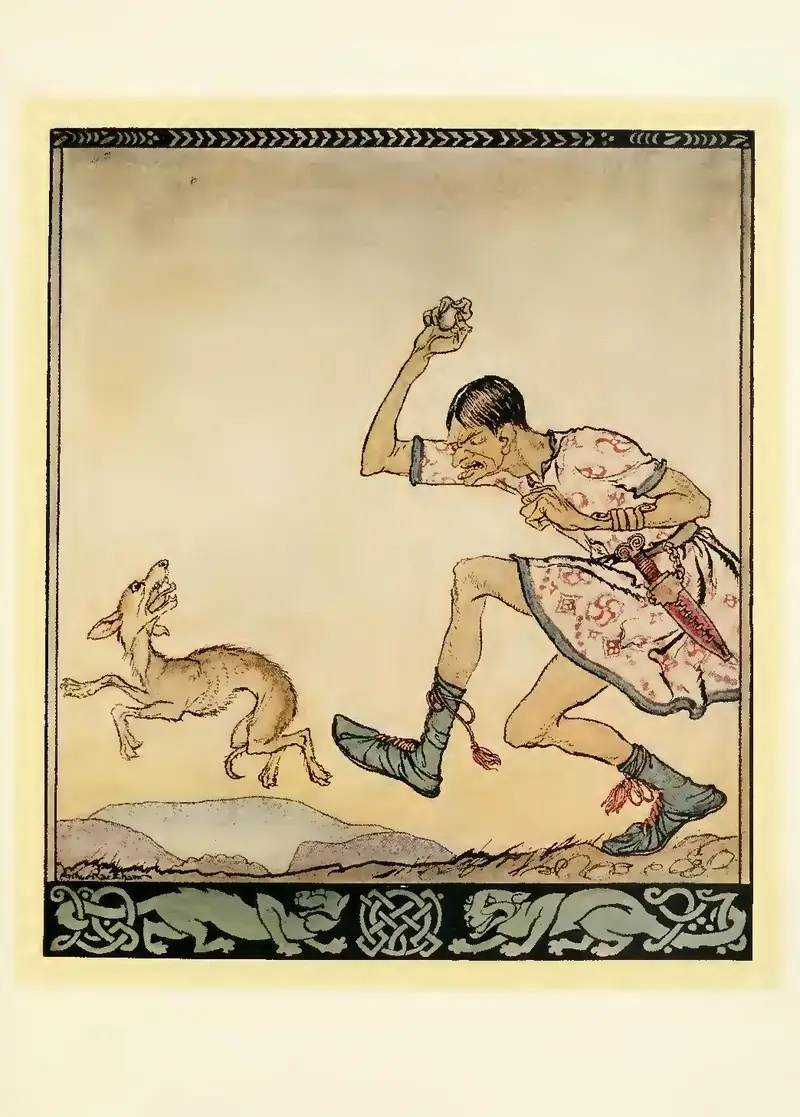
There are people who do not like dogs a bit—they are usually women—but in this story there is a man who did not like dogs. In fact, he hated them. When he saw one he used to go black in the face, and he threw rocks at it until it got out of sight. But the Power that protects all creatures had put a squint into this man’s eye, so that he always threw crooked.
This gentleman’s name was Fergus Fionnliath, and his stronghold was near the harbour of Galway. Whenever a dog barked he would leap out of his seat, and he would throw everything that he owned out of the window in the direction of the bark. He gave prizes to servants who disliked dogs, and when he heard that a man had drowned a litter of pups he used to visit that person and try to marry his daughter.
Now Fionn, the son of Uail, was the reverse of Fergus Fionnliath in this matter, for he delighted in dogs, and he knew everything about them from the setting of the first little white tooth to the rocking of the last long yellow one. He knew the affections and antipathies which are proper in a dog; the degree of obedience to which dogs may be trained without losing their honourable qualities or becoming servile and suspicious; he knew the hopes that animate them, the apprehensions which tingle in their blood, and all that is to be demanded from, or forgiven in, a paw, an ear, a nose, an eye, or a tooth; and he understood these things because he loved dogs, for it is by love alone that we understand anything.
Among the three hundred dogs which Fionn owned there were two to whom he gave an especial tenderness, and who were his daily and nightly companions. These two were Bran and Sceo’lan, but if a person were to guess for twenty years he would not find out why Fionn loved these two dogs and why he would never be separated from them.
Fionn’s mother, Muirne, went to wide Allen of Leinster to visit her son, and she brought her young sister Tuiren with her. The mother and aunt of the great captain were well treated among the Fianna, first, because they were parents to Fionn, and second, because they were beautiful and noble women.
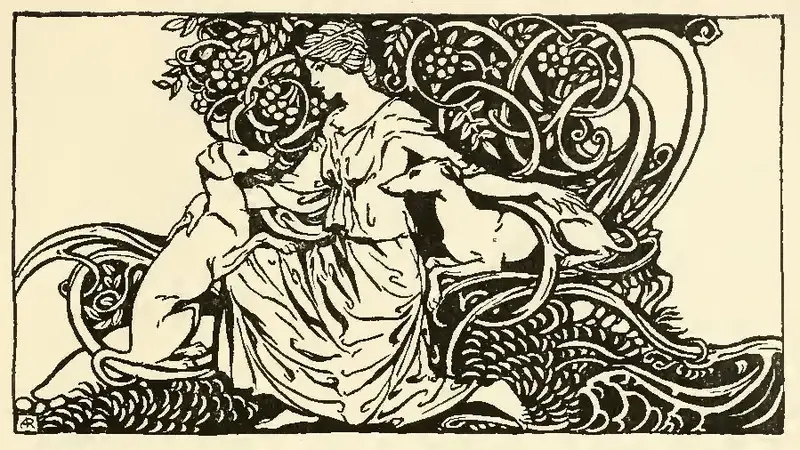
No words can describe how delightful Muirne was—she took the branch; and as to Tuiren, a man could not look at her without becoming angry or dejected. Her face was fresh as a spring morning; her voice more cheerful than the cuckoo calling from the branch that is highest in the hedge; and her form swayed like a reed and flowed like a river, so that each person thought she would surely flow to him.
Original Size
Men who had wives of their own grew moody and downcast because they could not hope to marry her, while the bachelors of the Fianna stared at each other with truculent, bloodshot eyes, and then they gazed on Tuiren so gently that she may have imagined she was being beamed on by the mild eyes of the dawn.
It was to an Ulster gentleman, Iollan Eachtach, that she gave her love, and this chief stated his rights and qualities and asked for her in marriage.
Now Fionn did not dislike the man of Ulster, but either he did not know them well or else he knew them too well, for he made a curious stipulation before consenting to the marriage. He bound Iollan to return the lady if there should be occasion to think her unhappy, and Iollan agreed to do so. The sureties to this bargain were Caelte mac Ronan, Goll mac Morna, and Lugaidh. Lugaidh himself gave the bride away, but it was not a pleasant ceremony for him, because he also was in love with the lady, and he would have preferred keeping her to giving her away. When she had gone he made a poem about her, beginning:
“There is no more light in the sky—”
And hundreds of sad people learned the poem by heart.